Walk into any restaurant, any waiting room, any living room after dinner, and you’ll see it: a child staring at a screen, a parent nearby, and a small bright rectangle sitting between them. It’s become the third person in the room.
UNICEF’s response to this is four verbs: read, talk, sing, and play. That’s it. No app, no gadget, no subscription. Just the oldest human tools we have for raising children.
This post breaks down what UNICEF actually recommends, what the research says behind it, and how to make it work in a real household with real time constraints.
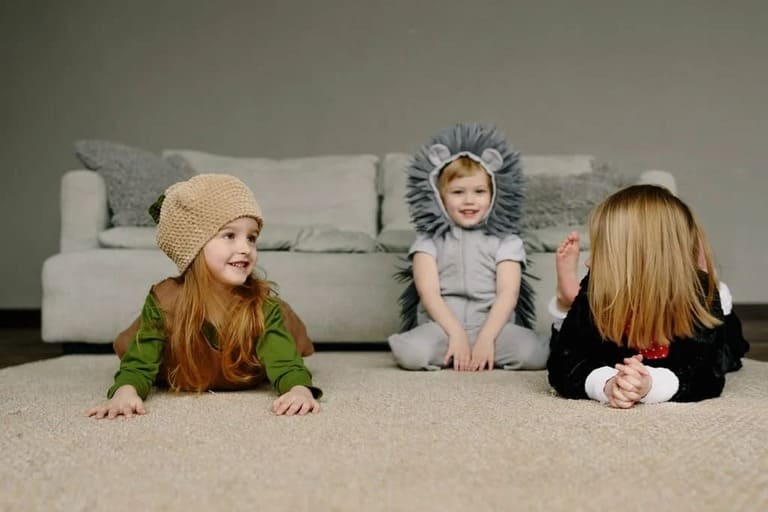
What UNICEF actually recommends
UNICEF’s screen-free guidance rests on one idea: for young children, the most important screen is a caregiver’s face. The most important content is the back-and-forth of shared attention.
The four activities:
- Read with your child. Books, picture cards, signs on the street, the cereal box label.
- Talk to your child. Narrate your day, ask open questions, listen more than you talk.
- Sing with your child. Nursery rhymes, made-up songs, silly voices, lullabies.
- Play with your child. Blocks, water, cardboard boxes, kitchen pots, the yard.
None of these requires a charger. All of them work in a high-rise in Mumbai, a refugee camp, a village in sub-Saharan Africa, or a suburban home in Toronto. That’s the point.
What the WHO and AAP say
UNICEF’s advice isn’t a solo opinion. It lines up with guidance from the World Health Organization and the American Academy of Pediatrics.
WHO guidelines (2019):
- Under 1 year: no screen time.
- 1 year: no sedentary screen time.
- 2 years: no more than one hour per day. Less is better.
- 3-4 years: no more than one hour per day. Less is better.
The WHO was explicit: the priority is active play and interactive, non-screen activities with a caregiver. That maps directly onto UNICEF’s four pillars.
AAP guidance:
- Under 18-24 months: avoid screens except video-chatting.
- 2-5 years: limit high-quality programming to one hour per day, and co-view with the child.
- All ages: designate screen-free times (meals, bedrooms, the hour before bed) and screen-free zones (the dinner table).
The AAP also coined the term “technoference” to describe how adult device use interrupts the back-and-forth between parent and child.
The “serve and return” model
Harvard University’s Center on the Developing Child came up with a useful concept called “serve and return.” A child “serves” (a babble, a gesture, a question) and a caregiver “returns” it (a word, a smile, a response). This back-and-forth is the primary way brain architecture gets built in the first three years.
Screens break the return. A tablet can’t mirror a baby’s expression. It can’t adjust its pace to a toddler’s confusion. It can’t laugh at the right moment.
A 2019 study in JAMA Pediatrics found that every additional hour of background television reduced the number of words a toddler heard and the number of vocalisations a toddler produced by roughly 10-20%. Not dramatic, but measurable. And it adds up.
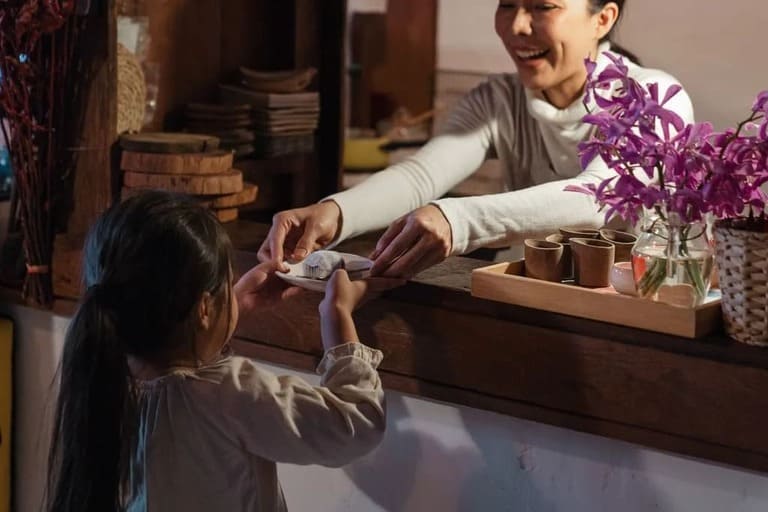
Read: the original download
Reading aloud to a child is the single most researched literacy intervention in existence. The evidence goes back more than four decades.
A 2019 meta-analysis in Educational Research Review found that shared book-reading produced gains in expressive and receptive language, phonological awareness, and early literacy outcomes across socioeconomic groups. The largest effects showed up for children from lower-income households.
The AAP now recommends that parents begin reading aloud from birth. Research shows the number of words a child hears by age three is strongly correlated with later reading success and school readiness. Learn more about early childhood development.
What works in practice:
- Start at birth. Even newborns benefit from the rhythm and warmth of a voice reading.
- Make it conversational, not performative. Pause on a page. Point. Ask: “What do you think the bear is feeling?”
- Re-read favourites. Repetition isn’t boredom. It’s the child’s first lesson in mastery.
- Re-tell stories in your own words. A made-up story about a mango-eating elephant beats a screen story the child passively absorbs.
Talk: the architecture of the mind
“Talk” in UNICEF’s sense isn’t lecturing. It’s the continuous, gentle narration of a shared life: “I’m cutting the onion now. It smells strong, doesn’t it? Yes, it makes your eyes water…”
This style of speech goes by different names: “parentese,” “language nutrition.” The effects are measurable.
A landmark 1995 study by Betty Hart and Todd Risley found that by age three, children of professional parents had heard roughly 30 million more words than children of parents on welfare. Subsequent research refined the finding: it’s the back-and-forth conversational turns, not the sheer word count, that drive language growth. But the underlying truth holds: talk shapes brains.
A 2018 study in Psychological Science by Wee et al. demonstrated that the number of conversational turns a child engaged in at 18-24 months was a stronger predictor of IQ and language scores at age nine than the family’s income or the parents’ education.
What works in practice:
- Drop to the child’s eye level. Mirror their action. Pause. Then add one word: “Dog. Big, spotty dog.”
- Narrate the boring parts of life. Folding laundry, washing dishes, walking to the bus. All of it is language.
- Ask open questions (What? How? Why?) and wait at least five seconds for the answer. Silences feel long to adults; they’re gold to a child learning to think.
- Bilingual households: speak the language you know best. Vocabulary depth matters more than the number of languages.
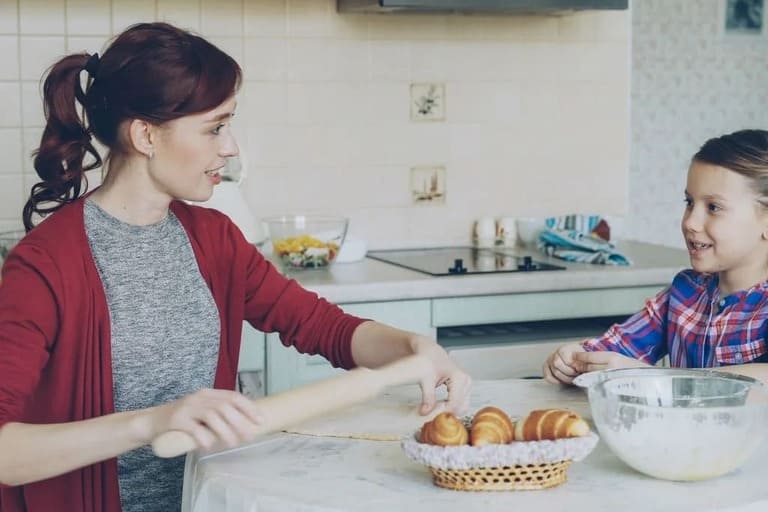
Sing: the first multisensory curriculum
Singing is reading’s louder, looser cousin. Long before alphabet blocks, there were lullabies.
Singing slows language down, stretching vowels and emphasising rhythm in ways that help a child parse the building blocks of speech. This is one reason children with language delays often respond to sung instructions before spoken ones. Read more about music and infant brain development.
Singing pairs language with movement (think “Head, Shoulders, Knees and Toes” or “The Wheels on the Bus”), recruiting the body as an additional memory channel.
Singing together releases oxytocin in both the singer and the listener. Same hormone involved in secure attachment.
What works in practice:
- The melody matters less than the presence. A parent humming off-key is doing more for their child than the world’s best streaming playlist.
- Pair songs with hand motions or simple dances. The motor cortex locks the memory in.
- Make up songs about your own life: a clean-up song, a brushing-teeth song, a “good morning, sun” song. Children don’t need polish; they need personalisation.
Play: the work of childhood
Piaget said play is the work of childhood. UNICEF picked “play” as the fourth pillar for a reason. It’s the integrative activity where the other three get practised at full stretch.
Different types of play build different capacities:
- Pretend and symbolic play (kitchens, dolls, “pretend shop”) builds language, theory of mind, self-regulation.
- Construction play (blocks, Lego, cardboard boxes) builds spatial reasoning, planning, persistence.
- Sensory play (water, sand, mud, paint) builds fine and gross motor control, scientific observation.
- Physical play (running, climbing, balance) builds cardiovascular health, vestibular system, risk assessment.
- Outdoor and nature play (parks, gardens, walks) builds attention restoration, immune regulation.
- Social play (with siblings, peers, parents) builds negotiation, empathy, conflict resolution.
A 2017 paper in Psychological Science by Schaefer et al. found that toddlers who engaged in more pretend play showed stronger self-regulation. That capacity is itself a stronger predictor of school success than IQ.
What works in practice:
- Provide open-ended materials (water, cardboard boxes, scarves, blocks) over highly prescriptive toys. The less the toy does, the more the child does.
- Follow the child’s lead. You’re not the director; you’re the co-star.
- Allow boredom. Boredom is the soil in which play grows.
- Get outside daily. Even 20 minutes of unstructured outdoor play is linked to measurable benefits in attention, mood, and sleep. See our guide on balancing physical activity and screen time.
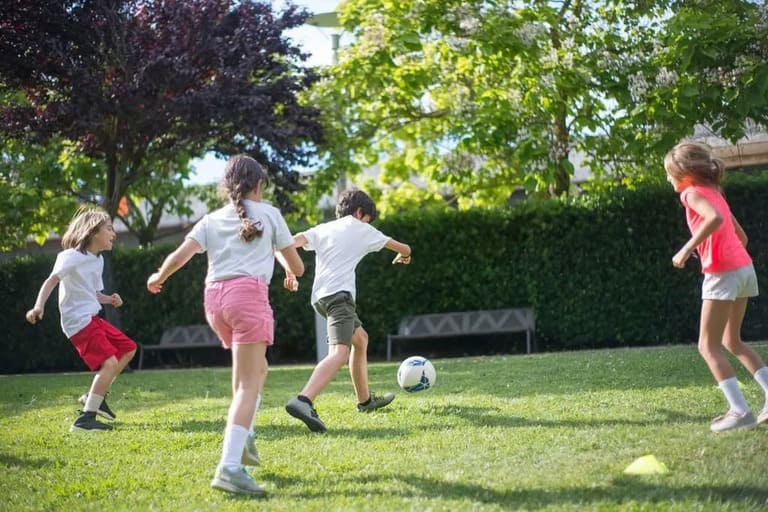
The hidden fifth verb: be present
There’s a fifth thing UNICEF’s framework assumes but doesn’t name: show up.
No curated content can replace a regulated, attentive adult. A 2017 Child Development study found that parental responsiveness (the speed and warmth of a caregiver’s reply to a child’s bid) was a stronger predictor of language development than the family’s socioeconomic status.
Studies of “technoference” show that even when the parent is in the same room, a parent on a phone responds more slowly, speaks less, and is more likely to react harshly to a child’s bids for attention. Compared to a parent whose phone is put away.
The good news: presence is a skill, not a personality trait. It can be practised, and it doesn’t need to be perfect to be powerful. Ten minutes of fully attentive play is worth more than three hours of side-by-side coexistence.
A practical framework for families
Understanding UNICEF’s advice isn’t the hard part. Doing it is. Here’s a structure that busy families can actually sustain.
The 10-Minute Rule
You don’t need to fill a child’s day with curated activities. You need 10 focused minutes, three times a day. A 10-minute morning cuddle-and-read. A 10-minute afternoon talk-walk. A 10-minute evening sing-and-tidy. That’s half an hour of true connection, and it outperforms three hours of background television.
Three screen-free zones
Borrowed from the AAP and adopted by parenting authorities worldwide:
- The dinner table. No screens, including for adults.
- The bedroom. No screens in or near where the child sleeps.
- The first hour after waking and the last hour before bed. Protect these transition times for human contact.
The “Yes Space”
A concept from the RIE (Resources for Infant Educarers) tradition: a corner of the home, a single safe room, a defined patch of garden, where the child can move and explore freely without being told “no.” In a yes space, screens become irrelevant because the world is already interesting.
Model the behaviour
Children don’t do as you say; they do as you do. If the parent’s phone is always in the hand, the child learns that the phone is the centre of the world. The single most powerful screen-time intervention a family can make is for the adults to put their own devices down during shared time. Learn more about healthy digital habits.
Build a “Boredom Kit”
A shoebox of crayons and paper, a few small figurines, a deck of cards, a pad of stickers, a ball, a torch, a picture book. That defuses 90% of “I’m bored” moments without recourse to a screen.
Common objections
“Educational apps prepare kids for the digital future.”
The AAP and WHO are clear: under 5, learning happens through the body, the voice, and the caregiver. Evidence that apps produce real learning gains in toddlers is weak and contested.
“Sometimes I need the screen to cook dinner or take a work call.”
The goal is balance, not perfection. Strategic, limited use is fine. The question is whether it’s the default or the exception.
“My toddler won’t sit through a book.”
Children aren’t designed to sit still. Read on the floor, in the bath, while they climb on you. Engagement isn’t the same as stillness.
“I don’t have time to play all day.”
The 10-Minute Rule was built for this. Three short, real moments beat one long, distracted one.
The bigger picture
UNICEF’s screen-free guidance sits inside a larger global conversation about childhood in the digital age. The organisation has warned repeatedly, in reports like Growing Up in a Connected World, that the digital divide is no longer just about access. It’s about protection from the harms of premature, excessive, and unmediated screen exposure.
This isn’t a call for digital abstinence. It’s a call for proportion. Putting the screen back in its proper place, as a tool in service of human connection, not a replacement for it.
The four verbs (read, talk, sing, play) predate the smartphone by roughly 200,000 years. They’ve built every human civilisation that has ever existed. They’re free, they’re universal, and by a wide margin, they’re the most evidence-backed developmental intervention science has ever identified.
A closing thought
Next time you reach for a screen to soothe, distract, or quiet a child, pause for ten seconds. In that pause, ask: what’s the smallest, most human thing I could do instead?
A line of a song. A sentence about what we’re doing. A page of a book, even upside down. A tower of blocks that we’ll knock down together.
That’s the whole programme. Not an app, not a gadget, not a setting. A decision, made ten seconds at a time, to be present with the child in front of you.
The screen will still be there tomorrow. Childhood won’t.